

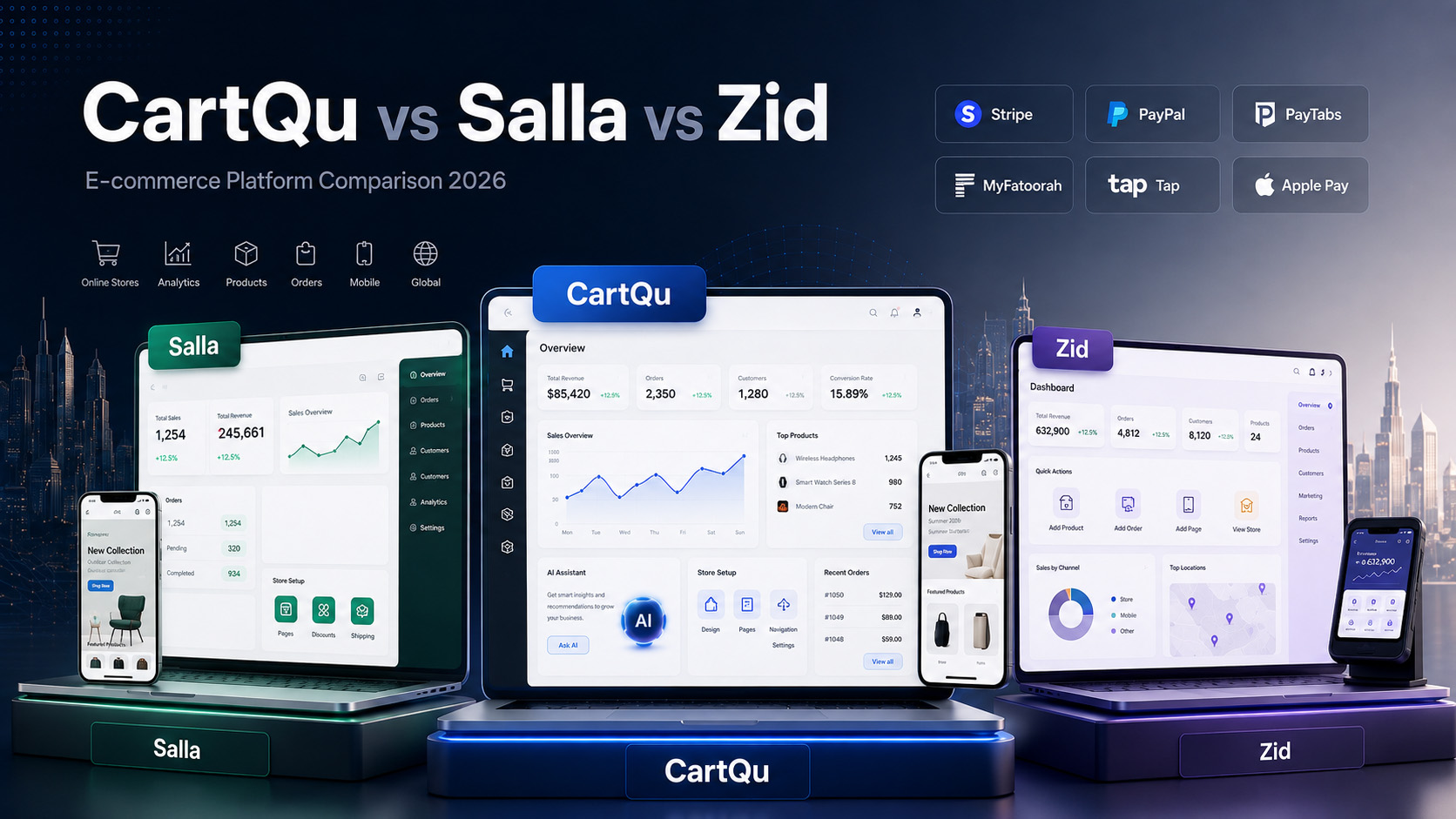
CartQu vs Salla vs Zid (2026): Full E-commerce Comparison
2026 E-COMMERCE PLATFORM COMPARISON
CartQu vs Salla vs Zid is a decision about operating model, not just subscription price. This guide compares the three platforms across the work that shapes a real store: payments, shipping, search visibility, customer operations, design, integrations, AI, physical retail, and expansion.
Last reviewed: August 28, 2026. Pricing, payment eligibility, feature access, and regional availability can change. Confirm final details on each platform’s official page before subscribing.
Official plan references: CartQu pricing, Salla packages, and Zid pricing.
CartQu at a glance
Best evaluated by teams that want Arabic-first storefronts, multi-store management, global and regional payment choices, and a hosted alternative to a more technical WooCommerce stack.
Salla at a glance
Best evaluated by Saudi-first merchants who want a mature local commerce ecosystem, marketplace extensions, local operating tools, and connected POS options.
Zid at a glance
Best evaluated by Saudi and GCC retailers for whom stores, branches, stock, shipping, marketplace reach, and POS are part of one operating model.
Last updated: August 28, 2026
Choosing an e-commerce platform in the Arab world is no longer simply a question of “Which platform lets me create an online store?”
Modern merchants need to consider much more:
- How much will the platform cost as the business grows?
- Does it support Arabic properly?
- Can it handle multiple stores?
- Which payment gateways are available?
- Can international payment providers such as Stripe and PayPal be used?
- Does it support Saudi-focused payment methods?
- Are cash on delivery and bank transfer available?
- How flexible is storefront design?
- Can the merchant use a custom domain?
- Does the platform support SEO?
- Are analytics and marketing integrations available?
- Can existing WooCommerce products be imported?
- Does the platform provide APIs?
- Does it support artificial intelligence?
- Is a physical point-of-sale system required?
- How strong are local shipping integrations?
- Is the merchant selling only in Saudi Arabia, or internationally?
- Will the merchant eventually need more than one online store?
Three names increasingly appear in this conversation: CartQu, Salla, and Zid.
All three can be used to build and operate online stores, but they are not identical products and they are not necessarily trying to solve exactly the same problem.
Salla has developed into one of the largest e-commerce ecosystems focused on Saudi Arabia and the wider region.
Zid has built a strong Saudi and GCC commerce ecosystem with particular strength in omnichannel retail, logistics, marketplaces, and physical retail operations.
CartQu takes a different approach: an Arabic-first but internationally oriented SaaS platform designed around straightforward store creation, flexible storefront components, multiple-store management, built-in commerce functionality, international and regional payment options, and predictable plans for small and growing businesses.
That means the correct question is not:
“Which platform is universally better?”
A more useful question is:
“Which platform is better for the type of commerce business I am building?”
This CartQu vs Salla vs Zid comparison examines pricing, online stores, Arabic support, payments, design, shipping, POS, AI, SEO, integrations, APIs, analytics, multi-store capabilities, international selling, migration, and other important differences.
CartQu vs Salla vs Zid: Quick Answer
For merchants who want the shortest possible answer:
Choose CartQu if:
You want an affordable, straightforward e-commerce platform with Arabic support, multiple stores under one account, flexible component-based storefronts, international and regional payment gateway options, API access on paid plans, analytics integrations, WooCommerce importing, and the ability to operate beyond a Saudi-only ecosystem.
CartQu is particularly interesting for:
- small and medium-sized businesses;
- entrepreneurs;
- creators;
- social sellers;
- home businesses;
- companies operating several online brands;
- Arabic businesses outside Saudi Arabia;
- merchants selling to multiple markets;
- merchants who prefer global payment providers such as Stripe and PayPal;
- merchants who want regional providers such as PayTabs, MyFatoorah, and Tap;
- businesses that want more commerce functionality directly in the platform instead of assembling a large collection of third-party apps.
CartQu publicly positions itself as an Arabic-first platform, while its storefront and management experience supports Arabic, English, and Turkish, including RTL support.
Choose Salla if:
Your business is heavily centered on Saudi Arabia and you want access to a very mature Saudi commerce ecosystem with extensive shipping relationships, local payments, POS capabilities, mobile-app creation, a large application marketplace, Saudi tax/e-invoicing support, and a very large existing merchant community.
Salla says it was founded in Makkah in 2016 and currently serves more than 68,000 active merchants, with more than SAR 50 billion in processed merchant sales.
Choose Zid if:
You are building a Saudi or GCC retail operation where physical stores, POS, inventory, marketplaces, branches, logistics, external sales channels, and omnichannel operations are particularly important.
Zid combines online-store functionality with products such as Zid Cashier, Zid Shipping, Zid Payments, Mazeed, external marketplace connections, and an expanding AI and developer ecosystem.
CartQu vs Salla vs Zid Comparison Table
| Feature | CartQu | Salla | Zid |
|---|---|---|---|
| Free plan | Yes | Yes | Yes |
| Entry paid plan | Growth: $20/month | Plus: SAR 990/year | Rise: SAR 99/month or SAR 990/year |
| Higher public plan | Enterprise: $60/month | Pro: SAR 2,990/year | Growth: SAR 299/month or SAR 2,990/year |
| Products on free plan | Unlimited | Unlimited | Unlimited |
| Multiple stores | 3 on Growth, 8 on Enterprise | Multi-store capabilities available particularly through larger-business offerings | Strong branch/retail capabilities; advanced business options available |
| Arabic | Yes | Yes | Yes |
| English | Yes | Yes | Yes |
| Turkish | Yes | Not a core differentiator | Not a core differentiator |
| RTL | Yes | Yes | Yes |
| International orientation | Strong | Expanding internationally | GCC-focused expansion |
| Component-based storefront builder | Yes | Store themes/editor | Theme/storefront ecosystem |
| Custom domain | Yes | Paid plans | Rise and above |
| Stripe | Yes | Platform emphasizes its local/regional payment ecosystem | Platform emphasizes Zid Payments |
| PayPal | Yes | Not a central Salla payment proposition | Not a central Zid payment proposition |
| PayTabs | Yes | Regional payment ecosystem | Platform payment ecosystem |
| MyFatoorah | Yes | Regional payment ecosystem | Platform payment ecosystem |
| Tap Payments | Yes | Regional payment ecosystem | Platform payment ecosystem |
| Apple Pay | Yes | Yes | Supported through payment ecosystem |
| Mada | Depends on connected gateway/provider | Strong native Saudi support | Strong native Saudi support |
| Cash on Delivery | Yes | Yes | Yes |
| Manual bank transfer | Yes | Available commerce workflows | Yes |
| GA4 | Yes | Available through ecosystem/tools | Available through ecosystem/tools |
| Meta Pixel | Yes | Available | Available |
| Google Tag Manager | Growth/Enterprise | Available through ecosystem/apps | Available through ecosystem/apps |
| Google Merchant Center | Eligible paid plans | Commerce/marketing ecosystem | Commerce/marketing ecosystem |
| Click-to-chat integration | Ecosystem integrations | Strong WhatsApp ecosystem/tools | |
| WooCommerce importer | Yes | Migration options/tools | Migration tools available |
| CSV/Excel import | Yes | Yes | Yes |
| API | Growth/Enterprise | Yes | Yes |
| Webhooks/custom integrations | Available for qualified requirements | Large developer platform | Developer/API platform |
| AI | AI credits and assistant | Extensive AI ecosystem | Extensive Zid AI ecosystem |
| Native/connected POS | Not currently a core CartQu proposition | Salla Point | Zid Cashier |
| Shipping ecosystem | Delivery zones; carrier integrations expanding | Very extensive | Very extensive |
| App marketplace | Smaller/integrated approach | Large marketplace | Large marketplace |
| Marketplace selling | Not currently its main proposition | Integrations/ecosystem | Mazeed + external channels |
| Best fit | Flexible, affordable, multi-store SMB and cross-border commerce | Mature Saudi commerce ecosystem | Saudi/GCC omnichannel retail |
Current pricing comes directly from each platform’s public pricing information. CartQu lists Starter at $0, Growth at $20/month, and Enterprise at $60/month. Salla lists Basic as free, Plus at SAR 990 per year, Pro at SAR 2,990 per year, and a custom enterprise offering. Zid lists Starter as free, Rise at SAR 99 per month or SAR 990 annually, Growth at SAR 299 per month or SAR 2,990 annually, and a custom Professional tier.
Prices and features can change, so merchants should always verify the latest plan before subscribing.
1. What Is CartQu?
CartQu — كارت كيو in Arabic — is a hosted e-commerce platform designed to help businesses create, manage, and grow online stores without having to build the underlying commerce infrastructure themselves.
It provides functionality for storefronts, products, product variants, inventory, customers, orders, payments, content, analytics, domains, integrations, APIs, and other essential commerce operations.
CartQu’s public product information describes centralized store management, flexible product management, order and payment controls, analytics, customizable storefront components, inventory tools, CRM functionality, discount tools, and APIs.
One particularly important distinction is that CartQu is designed around multiple stores rather than assuming every customer will operate only one storefront.
Its current pricing includes:
- Starter — $0/month: one store and unlimited products.
- Growth — $20/month: up to three stores, up to 5,000 products, API access, advanced analytics, 500 monthly AI credits, and a basic AI assistant.
- Enterprise — $60/month: up to eight stores, unlimited products, API access, advanced analytics, 2,000 monthly AI credits, an advanced AI assistant, priority support, and onboarding.
This can make CartQu especially interesting for entrepreneurs who manage several brands or want to launch different stores for different products, countries, audiences, or business concepts.
CartQu also supports a mixture of international and Middle Eastern payment infrastructure, including Stripe, PayPal, PayTabs, MyFatoorah, Tap Payments, Apple Pay, cash on delivery, and manual bank transfer. Actual availability can still depend on the merchant’s country and each payment provider’s eligibility requirements.
2. What Is Salla?
Salla is one of the best-known e-commerce platforms originating from Saudi Arabia.
Founded in Makkah in 2016, Salla has grown far beyond a basic website builder. It now operates a substantial commerce ecosystem spanning online storefronts, payments, shipping, apps, POS, mobile applications, marketing, artificial intelligence, developers, and other merchant services.
According to Salla’s own current platform information, it serves more than 68,000 active merchants and has processed more than SAR 50 billion in merchant sales.
This scale matters.
When choosing Salla, a merchant is not merely buying an online-store builder. The merchant is entering a large Saudi-centered commerce ecosystem.
That makes Salla especially compelling for businesses whose operations are deeply connected to Saudi:
- payment methods;
- shipping providers;
- e-invoicing;
- VAT workflows;
- local consumer expectations;
- local applications;
- physical retail;
- local marketing channels.
Salla currently advertises support for dozens of languages, cross-border payments, international shipping, multiple branches and warehouses, and other capabilities as the platform expands beyond its original Saudi footprint.
3. What Is Zid?
Zid is another major Saudi commerce platform, but its positioning extends particularly strongly into omnichannel retail operations.
Zid’s ecosystem includes:
- online storefronts;
- Zid Payments;
- Zid Shipping;
- Zid Cashier POS;
- themes;
- apps;
- APIs;
- marketplace tools;
- Mazeed;
- external sales-channel connections;
- inventory and branch management;
- artificial intelligence.
Its capabilities make it particularly relevant to retailers that do not think of “e-commerce” and “physical retail” as separate businesses.
For example, Zid Cashier connects store operations, inventory, branches, reports, invoices, barcodes, and physical checkout workflows.
Zid has also expanded marketplace and external sales-channel functionality. Its sales-channel tools currently include connections involving channels such as Amazon, Trendyol, Jahez, and its own Mazeed marketplace.
For an established Saudi retailer with physical branches and online marketplace ambitions, that can be extremely valuable.
4. CartQu vs Salla vs Zid Pricing
Pricing is one of the clearest differences between the three platforms.
CartQu pricing
CartQu currently offers:
CartQu Starter — $0/month
Includes:
- one store;
- unlimited products;
- essential store-management functionality.
The Starter plan does not include CartQu’s AI credits, advanced analytics, AI assistant, or API access.
CartQu Growth — $20/month
Includes:
- up to three stores;
- up to 5,000 products;
- 500 AI credits per month;
- basic AI assistant;
- advanced analytics;
- API access;
- email and chat support.
CartQu Enterprise — $60/month
Includes:
- up to eight stores;
- unlimited products;
- 2,000 AI credits per month;
- advanced AI assistant;
- advanced analytics;
- API access;
- priority support;
- onboarding.
This pricing structure is unusual in one important respect:
multiple stores are included relatively early.
A business paying $20 per month can operate up to three CartQu stores according to the current pricing page.
That can materially affect total platform costs for someone running several brands.
Salla pricing
Salla currently offers:
Salla Basic — Free
The free plan includes:
- unlimited products;
- unlimited orders;
- unlimited customers;
- discount functionality;
- product ratings and questions;
- access to discounted Salla shipping labels.
Salla Plus — SAR 990/year
Adds capabilities including:
- online payment acceptance;
- local and international shipping functionality;
- custom domain;
- support for different product types;
- Salla Point;
- more than 30 additional platform capabilities.
Salla Pro — SAR 2,990/year
Adds more advanced functionality such as:
- VAT configuration;
- employee accounts;
- CSS and JavaScript customization;
- marketing tools;
- accounting and financial capabilities;
- more than 50 additional capabilities.
Salla also offers a larger-business/enterprise service with custom pricing and features such as multiple stores, branches, teams, ERP integrations, and dedicated success services.
Zid pricing
Zid currently offers:
Zid Starter — Free
Includes:
- unlimited products;
- unlimited orders;
- unlimited customers;
- coupons;
- bank transfer;
- cash on delivery;
- Zid logistics access;
- Mazeed marketplace participation;
- basic POS access.
Zid Rise — SAR 99/month or SAR 990/year
Adds capabilities including:
- custom domain;
- advanced payment functionality;
- additional store features.
Zid Growth — SAR 299/month or SAR 2,990/year
Adds:
- up to five team members;
- more advanced tax and invoice settings;
- greater storefront customization;
- additional business functionality.
Zid Professional
Available with custom pricing for larger organizations and more advanced operational requirements.
5. Which Is Cheapest: CartQu, Salla, or Zid?
There is no single answer because the platforms price different features differently.
All three offer a free starting option.
However, merchants should not evaluate price only by asking:
“What is the cheapest subscription?”
They should ask:
“How much will my complete commerce stack cost?”
That can include:
- store subscription;
- additional stores;
- premium applications;
- themes;
- payment fees;
- shipping software;
- analytics;
- API access;
- AI features;
- POS;
- staff accounts;
- custom development;
- integrations.
For a business that primarily needs a straightforward online store or several online stores, CartQu’s $20 Growth plan can be particularly attractive because it includes up to three stores, advanced analytics, API access, and AI credits in one subscription.
For a merchant whose business depends heavily on Salla’s extensive shipping, POS, application marketplace, and Saudi merchant ecosystem, the higher overall cost may be justified.
Likewise, a physical retailer using Zid Cashier, Zid Shipping, marketplaces, and branch functionality should evaluate Zid as an operational commerce system rather than simply comparing the subscription price with a website builder.
6. Free Plan Comparison
All three platforms deserve credit for offering a free entry point.
CartQu Starter
CartQu Starter currently provides:
- one online store;
- unlimited products;
- hosted commerce infrastructure;
- core product and store-management capabilities.
Its paid tiers introduce capabilities such as API access, AI credits, advanced analytics, and multiple-store capacity.
Salla Basic
Salla Basic provides unlimited products, orders, and customers along with several core merchant features. Online payment capabilities and features such as custom domains become important reasons to move into paid Salla tiers.
Zid Starter
Zid Starter includes unlimited products, customers, and orders, along with cash on delivery, bank transfer, logistics access, and Mazeed participation. More advanced payments and custom-domain functionality are associated with higher plans.
The free plans therefore serve slightly different purposes.
For testing a business idea, all three can work.
For evaluating long-term cost, merchants should compare the first paid tier that actually contains the capabilities they need.
7. Multi-Store Management: A Major CartQu Difference
This is one of CartQu’s most meaningful differentiators.
Many e-commerce businesses eventually operate more than one storefront.
Examples include:
- one store for Saudi Arabia and another for another market;
- separate B2C and B2B stores;
- several brands owned by the same entrepreneur;
- a main brand and a niche product brand;
- temporary campaign stores;
- different stores for different industries;
- agencies managing several commerce projects.
CartQu Growth supports up to three stores, while CartQu Enterprise supports up to eight stores.
Salla absolutely supports larger multi-store and multi-branch operations, particularly through higher-level offerings, and Zid has significant branch, warehouse, POS, and retail-management functionality.
But the positioning differs.
CartQu makes multiple independent stores a visible part of its regular SaaS plans.
For a small company that plans to own several online brands but does not yet need an enterprise contract, this can be a significant reason to choose CartQu over Salla or Zid.
8. Arabic and RTL Support
Any platform competing seriously in Arab markets must do more than translate a few buttons.
Arabic commerce requires consideration of:
- RTL interfaces;
- Arabic storefronts;
- Arabic product content;
- Arabic menus;
- Arabic checkout;
- Arabic SEO metadata;
- Arabic customer communication;
- Arabic-friendly theme layouts.
All three platforms have strong reasons to support Arabic.
Salla and Zid were built in Saudi Arabia and naturally serve Arabic-speaking merchants.
CartQu is explicitly positioned as Arabic-first and currently supports Arabic, English, and Turkish experiences with RTL support.
This combination can be particularly useful for businesses operating between the Arab world and Turkey, or merchants who want an Arabic-first platform without restricting the overall product to one national market.
9. Multilingual and International Commerce
This is an area where merchants should distinguish between:
- a platform being Arabic-friendly;
- a platform supporting multiple languages;
- a platform being designed around international operations.
Salla has made significant progress in international commerce and currently advertises support for more than 40 languages, payments from many countries, international shipping, and multi-currency commerce.
Zid has also expanded its operations throughout the GCC and publicly promotes store creation for merchants across Gulf markets.
CartQu’s positioning is somewhat different.
Rather than building primarily around a Saudi-only operational environment, CartQu combines:
- Arabic-first commerce;
- English;
- Turkish;
- international payment gateways;
- GCC payment gateways;
- custom domains;
- hosted storefront infrastructure.
This gives CartQu a useful positioning between fully global platforms and Saudi-specific platforms.
For example, a merchant wanting Stripe + PayPal + PayTabs + MyFatoorah + Tap within the same platform proposition may find CartQu particularly attractive.
Payment gateway eligibility, however, always depends on the provider and merchant country. A platform supporting Stripe does not automatically mean Stripe will onboard a merchant in every country.
10. CartQu vs Salla vs Zid for Storefront Design
Storefront design affects much more than appearance.
It influences:
- conversion;
- mobile usability;
- brand differentiation;
- merchandising;
- campaign creation;
- landing pages;
- site speed;
- SEO structure.
CartQu storefront design
CartQu uses a component-based, no-code storefront approach.
Rather than treating a theme as an unchangeable template, merchants can work with predefined storefront components and arrange or replace those components when constructing pages.
CartQu describes its storefront capabilities around customizable themes, components, custom branding, mobile-friendly interfaces, and a no-code page-building experience.
Custom component work can also be requested for businesses that need specialized theme, layout, or component behavior.
This model is particularly useful when a merchant wants customization without maintaining a custom-coded storefront.
Salla design
Salla has a mature theme and storefront ecosystem, with both platform capabilities and marketplace extensions.
Its larger ecosystem gives merchants substantial choice, and Salla Pro also includes deeper CSS and JavaScript customization capabilities.
Zid design
Zid also maintains a substantial themes ecosystem, with ready-made themes, customization options, and developer-oriented theme capabilities.
Design verdict
Choose CartQu if you prefer an integrated component-based builder and straightforward customization.
Choose Salla or Zid if access to a larger existing marketplace of themes and third-party design resources is more important.
11. Product and Inventory Management
An e-commerce platform becomes difficult to migrate away from once a catalog grows, so catalog capabilities matter from the beginning.
CartQu includes functionality covering:
- products;
- variants;
- product attributes;
- inventory;
- stock;
- pricing;
- product imagery;
- product organization;
- discounts;
- collections and merchandising;
- orders and customer information.
Its public product information highlights variant management, inventory, pricing, and broader catalog-management capabilities.
Salla and Zid similarly provide mature catalog and inventory tools, especially as part of their broader merchant ecosystems.
Where Zid becomes particularly compelling is for businesses that must synchronize inventory across physical branches, POS operations, and online commerce.
Where Salla becomes compelling is the breadth of complementary services that can be layered onto product operations through its ecosystem.
Where CartQu is compelling is keeping the core online-store operation relatively centralized and straightforward.
12. Payment Gateways: CartQu vs Salla vs Zid
Payments are one of the most important differences.
There are two distinct merchant needs:
Local Saudi commerce
A Saudi merchant may prioritize:
- Mada;
- Apple Pay;
- STC Pay;
- Tabby;
- Tamara;
- Saudi bank/payment infrastructure.
International or cross-border commerce
Another merchant may prioritize:
- Stripe;
- PayPal;
- PayTabs;
- MyFatoorah;
- Tap;
- international cards;
- country-specific regional providers.
These are different requirements.
13. CartQu Payments
CartQu currently lists support for:
- Stripe
- PayPal
- PayTabs
- MyFatoorah
- Tap Payments
- Apple Pay
- Cash on Delivery
- Manual Bank Transfer
That is one of CartQu’s most strategically important capabilities.
Stripe and PayPal are internationally recognized payment providers.
PayTabs, MyFatoorah, and Tap have significant relevance in Middle Eastern markets.
Cash on delivery remains important in parts of the region.
Manual bank transfer is useful for markets and B2B scenarios where card-payment penetration may be lower.
This mixture allows CartQu to target businesses whose payment requirements do not fit neatly into a Saudi-only model.
14. Salla Payments
Salla has an extremely strong Saudi payments proposition.
Its payment ecosystem includes major payment methods such as:
- Mada;
- Visa;
- Mastercard;
- Apple Pay;
- BNPL services such as Tabby and Tamara;
- other regional methods and services.
Salla also advertises payment capabilities across numerous currencies and countries as its international offering expands.
For a merchant whose primary customer base is Saudi Arabia, this tight localization is an important Salla advantage.
15. Zid Payments
Zid Payments similarly focuses strongly on commerce in Saudi Arabia and the region.
Zid advertises quick activation and supports important card and local-payment workflows, while plan-specific payment fees and capabilities vary.
For Saudi retailers already using the wider Zid ecosystem, having payments integrated alongside shipping, POS, marketplaces, and operations can be more important than access to a broader collection of independent international gateway brands.
16. Which Platform Has Better Payments?
The answer depends on the merchant.
CartQu has an advantage when:
- Stripe is important;
- PayPal is important;
- the business operates internationally;
- the merchant wants several independent GCC payment providers;
- the merchant needs COD or bank transfer;
- payment flexibility across markets matters.
Salla has an advantage when:
- the business is strongly Saudi-focused;
- deep Mada support is important;
- BNPL services are important;
- the merchant wants payments embedded in a large Saudi ecosystem.
Zid has an advantage when:
- payments need to function as part of a larger Zid retail stack;
- the merchant uses Zid POS, logistics, branches, or marketplace tools;
- Saudi operational integration matters more than independent gateway choice.
17. Shipping and Logistics
This is an area where Salla and Zid currently have a major ecosystem advantage over CartQu.
It is important to state this clearly.
Salla shipping
Salla provides access to a substantial shipping ecosystem involving many local and international logistics providers. Salla’s platform information references more than 200 shipping partners and integrated tools for labels, COD, reports, local and international delivery, shipping rules, and discounted merchant rates.
For Saudi merchants shipping large order volumes, this can be extremely valuable.
Zid shipping
Zid similarly operates a strong logistics offering, including unified relationships with local and international carriers, COD, labels, shipment-status synchronization, reporting, and negotiated rates.
CartQu shipping
CartQu currently provides built-in delivery-zone functionality and is expanding its carrier-integration ecosystem.
Therefore:
If your number-one requirement is a mature built-in Saudi carrier network today, Salla or Zid currently has the stronger proposition.
If your delivery operation uses custom pricing, local couriers, delivery zones, manual logistics, or external integrations, CartQu may still be fully suitable.
This is also an area where CartQu can continue closing the ecosystem gap over time.
18. Physical Point of Sale: Salla vs Zid vs CartQu
Businesses with physical stores need to pay close attention to this section.
Salla Point
Salla offers Salla Point, a POS solution connected to the merchant’s Salla operations.
It supports physical checkout workflows and integrates with methods including cards, Mada, Apple Pay, Tabby, Tamara, cash, and QR-oriented payment experiences.
Zid Cashier
Zid has invested significantly in Zid Cashier, which connects physical retail with online inventory, branches, reports, invoices, barcodes, and other merchant operations.
CartQu
A native physical POS product is not currently one of CartQu’s central public propositions.
Therefore, a merchant operating a large network of physical stores today should examine Salla Point and Zid Cashier very carefully.
However, an online-first business should not automatically pay for or choose an ecosystem based on POS capabilities it may never use.
That distinction matters.
19. Marketplaces and Additional Sales Channels
Zid has a particularly interesting advantage here.
Through its commerce ecosystem, Zid supports channels involving:
- Mazeed;
- Amazon;
- Trendyol;
- Jahez;
- other external channels and marketplace relationships.
That is useful for merchants who want to distribute inventory across multiple established marketplaces rather than relying entirely on their own store.
Salla’s large application and integration ecosystem also supports broader multichannel selling.
CartQu currently focuses more heavily on giving the merchant control over the merchant’s own storefronts and integrations.
That can actually be an advantage for a different kind of company:
a merchant whose brand and owned storefront are the center of the strategy rather than marketplace distribution.
20. App Marketplace vs Built-In Functionality
One of the biggest architectural differences between younger and older commerce platforms is the role of third-party applications.
Salla has a very large application ecosystem. Current official pages refer to hundreds of apps and integrations; different Salla pages describe the ecosystem using counts such as more than 550 apps and more than 900 apps/integrations depending on the category being counted.
Zid likewise operates an app marketplace covering categories such as:
- marketing;
- customer support;
- inventory;
- accounting;
- analytics;
- productivity;
- payments;
- mobile apps;
- shipping;
- operations.
This is an enormous advantage when a merchant has a specialized requirement.
But an application marketplace can also introduce:
- additional subscriptions;
- additional vendor relationships;
- configuration complexity;
- compatibility considerations;
- fragmented support;
- dependence on third parties.
CartQu’s approach is currently smaller and more integrated.
That means:
Salla and Zid have greater ecosystem breadth.
CartQu can be simpler for businesses that prefer to get their essential functionality from the commerce platform itself.
Neither approach is universally superior.
21. API and Developer Capabilities
Developers and larger businesses should never choose an e-commerce system without considering its API strategy.
CartQu API
CartQu includes API access with Growth and Enterprise plans. It also makes webhook, automation, and custom integration work available for qualified business requirements.
This allows CartQu to serve companies that eventually need:
- ERP synchronization;
- external inventory systems;
- mobile applications;
- automation;
- analytics pipelines;
- custom dashboards;
- fulfillment integrations;
- specialized business workflows.
Salla developer ecosystem
Salla has a mature developer ecosystem supporting APIs as well as public and private applications.
Zid developer ecosystem
Zid similarly provides APIs and supports different application models, including public and private applications and shipping/integration use cases.
For the broadest existing developer/application ecosystem, Salla and Zid are currently more mature.
For a company that wants a clean API alongside a smaller, more straightforward commerce stack, CartQu can be an attractive alternative.
22. Marketing Integrations
CartQu currently includes or supports important digital marketing integrations such as:
- Google Analytics 4
- Meta Pixel
- Google Tag Manager on eligible paid plans
- Google Merchant Center feed on eligible paid plans
- WhatsApp click-to-chat
- additional custom integration capabilities.
These integrations matter because they cover several of the most common acquisition and analytics workflows without requiring an enormous application catalog.
Salla and Zid also support extensive marketing and advertising ecosystems, often through built-in capabilities and marketplace applications.
For businesses with very specialized marketing stacks, Salla and Zid’s mature app ecosystems may offer more ready-made choices.
For merchants primarily using Meta, Google, WhatsApp, and standard commerce analytics, CartQu already covers much of the essential stack.
23. WhatsApp Commerce
WhatsApp is far more important to commerce in the Middle East than it is in many Western markets.
Customers frequently use WhatsApp to ask about:
- product availability;
- sizes;
- colors;
- customization;
- delivery;
- payment;
- bulk orders;
- order status.
CartQu includes a merchant-level WhatsApp click-to-chat integration, allowing merchants to connect their public WhatsApp number and use contextual messaging from their storefront.
Salla and Zid also provide extensive WhatsApp-related capabilities through their respective ecosystems.
For small merchants who primarily need customers to move smoothly from a product or store page into a WhatsApp conversation, CartQu’s integrated approach is straightforward.
24. Analytics and Business Intelligence
All commerce businesses eventually need to understand:
- revenue;
- sales;
- conversion;
- products;
- customers;
- orders;
- stock;
- acquisition;
- repeat purchases.
CartQu Growth and Enterprise include advanced analytics according to the platform’s current pricing structure.
CartQu also supports GA4 and Meta Pixel, enabling merchants to combine platform analytics with external acquisition measurement.
Salla and Zid provide extensive reporting capabilities as well, with additional ecosystem applications available for merchants requiring deeper analysis.
Zid becomes particularly interesting when analytics must incorporate physical stores, branches, POS, and multi-channel operations.
25. Customer Management and CRM
CartQu’s commerce functionality extends beyond a product catalog.
Its platform describes CRM-style functionality including customer profiles, histories, notes, tasks, timelines, active carts, segmentation, and other customer-management capabilities.
For small and medium businesses, having customer information close to commerce operations can reduce the need to immediately deploy a separate CRM.
As companies become more sophisticated, the API can also be used to connect specialized CRM or marketing systems.
Salla and Zid similarly provide customer-management functionality and access to broader ecosystems when more advanced tooling is required.
26. SEO: CartQu vs Salla vs Zid
SEO should be treated as a core commerce feature, not a plugin that is added after launch.
A properly structured e-commerce site needs:
- indexable product pages;
- meaningful category pages;
- page titles;
- meta descriptions;
- canonical URLs;
- crawlable content;
- mobile performance;
- internal linking;
- localized content;
- clean URL structure.
Salla markets SEO capabilities as part of its commerce platform and has mature tools for multilingual product and metadata management.
Zid similarly provides SEO-oriented storefront capabilities and now includes SEO assistance within parts of its AI product tooling.
CartQu is also designed around indexable storefronts and includes control over store content, pages, products, custom domains, and related commerce content. Its platform is increasingly structured around both traditional SEO and answer-engine visibility.
The real SEO difference, however, usually comes down to merchant execution.
No platform can compensate for:
- copied product descriptions;
- thin category pages;
- poor internal links;
- weak brand signals;
- no backlinks;
- no editorial content;
- no product expertise;
- duplicate content.
The best platform is the one that gives the business enough technical control while allowing the team to consistently publish useful content.
27. AI and Artificial Intelligence Features
AI is rapidly becoming a standard part of e-commerce software.
This is one area where all three platforms are actively developing.
CartQu AI
Current CartQu plans integrate an AI credit system.
Growth currently includes:
- 500 AI credits per month;
- a basic AI assistant.
Enterprise currently includes:
- 2,000 AI credits per month;
- a more advanced AI assistant.
CartQu’s AI direction is built around helping merchants work with commerce content and other store-management workflows directly from the platform.
Salla AI
Salla has invested extensively in AI.
Its current AI capabilities include tools for creating stores from prompts, generating product content, SEO workflows, merchant assistance, and other store operations. Salla also provides functionality connecting stores to AI environments through technologies such as MCP.
Zid AI
Zid has also expanded aggressively into AI.
Current Zid AI capabilities include tools for:
- product writing;
- SEO title and description generation;
- background editing;
- product photography;
- store auditing;
- logo creation;
- banner design;
- theme content;
- data migration.
Zid also offers an MCP-oriented AI application designed to connect commerce operations with tools such as ChatGPT, Claude, Cursor, Codex, and n8n.
AI verdict
If a merchant is choosing purely on the breadth of AI functionality available today, Salla and Zid currently demonstrate broader mature AI ecosystems.
CartQu’s advantage is different: AI functionality is being built into a simpler platform and included through a predictable credit model.
As CartQu develops, AI can become an increasingly important differentiator, particularly if AI functionality extends beyond content generation into store operations, merchandising, analytics, customer management, and automation.
28. WooCommerce Migration
Migration is often ignored during platform selection.
For an existing merchant, manually recreating hundreds or thousands of products is unacceptable.
CartQu currently provides a WooCommerce catalog importer as well as CSV/Excel import capabilities.
This makes CartQu especially relevant to merchants searching for:
- WooCommerce alternatives;
- hosted WooCommerce alternatives;
- Arabic WooCommerce alternatives;
- easier alternatives to self-hosted e-commerce;
- ways to move from WordPress to SaaS e-commerce.
WooCommerce offers enormous flexibility, but merchants must also maintain hosting, WordPress, plugins, updates, compatibility, security, and performance.
A hosted platform such as CartQu can remove much of that infrastructure responsibility. CartQu’s own platform guidance emphasizes this difference when discussing hosted commerce for Arabic businesses.
29. Custom Domains
Serious businesses should use their own domain.
A custom domain provides:
- stronger branding;
- customer trust;
- SEO continuity;
- professional email possibilities;
- better portability of brand authority.
CartQu supports custom domains.
Salla provides custom-domain functionality on eligible paid tiers, including Plus.
Zid makes custom domains available starting with Rise according to its current plan comparison.
If SEO matters, using your own domain from the beginning is highly recommended regardless of platform.
30. Saudi VAT and ZATCA Compliance
For Saudi businesses, tax compliance can be more important than storefront design.
Salla has developed deeply localized Saudi tax and e-invoicing capabilities as part of its ecosystem.
Zid also provides direct Saudi ZATCA/Fatoora-oriented e-invoicing functionality and has continued updating those integrations in 2026.
This is one of the areas where mature Saudi platforms have an obvious advantage.
Businesses whose primary requirement is tightly integrated Saudi accounting and tax workflows should therefore compare Salla and Zid very carefully.
CartQu’s stronger case is for merchants whose operations span markets or whose commerce requirements are not defined primarily by Saudi-specific back-office systems.
31. Salla’s Biggest Advantages
A fair comparison must acknowledge why Salla has become successful.
Its major advantages include:
1. Scale
More than 68,000 active merchants gives Salla an enormous amount of ecosystem momentum.
2. Saudi localization
Payments, shipping, tax, checkout expectations, and merchant services have been built deeply around Saudi commerce.
3. Shipping ecosystem
Access to a very large network of logistics providers is difficult for smaller competitors to reproduce quickly.
4. App ecosystem
Hundreds of extensions provide solutions for specialized use cases.
5. Salla Point
Physical retailers have access to a connected POS platform.
6. Mobile-app builder
Salla offers tools allowing merchants to create native mobile commerce applications without developing them from scratch.
7. AI investment
Salla is actively incorporating AI into store creation, content, operations, SEO, and external AI connections.
If those are the capabilities your company needs most, Salla may be the correct choice.
32. Zid’s Biggest Advantages
Zid has a somewhat different collection of strengths.
1. Omnichannel commerce
Zid has built a strong connection between online selling and physical retail.
2. Zid Cashier
Its POS ecosystem gives retailers substantial operational capabilities.
3. Shipping
Zid provides a mature logistics system for merchants handling local and international deliveries.
4. Mazeed
Zid operates its own marketplace-oriented channel through Mazeed.
5. External sales channels
Amazon, Trendyol, Jahez, Mazeed, and other channels can expand merchant distribution.
6. AI
Zid’s AI toolkit now covers several practical merchant workflows rather than only text generation.
7. APIs and applications
The platform supports an established ecosystem of developers and integrations.
For a Saudi or GCC retailer building a complex omnichannel operation, these advantages are substantial.
33. CartQu’s Biggest Advantages
CartQu should not try to win by copying every feature of much larger ecosystems.
Its more compelling advantages are different.
1. Affordable multi-store commerce
CartQu Growth supports up to three stores for $20/month, while Enterprise supports up to eight stores for $60/month.
For founders running several brands, this can be one of the strongest reasons to consider CartQu.
2. International + Middle Eastern payment gateway combination
CartQu combines:
- Stripe;
- PayPal;
- PayTabs;
- MyFatoorah;
- Tap;
- Apple Pay;
- COD;
- bank transfer.
This is particularly relevant for businesses that exist between global and Middle Eastern commerce ecosystems.
3. Arabic-first without being Saudi-only
CartQu supports Arabic while also supporting English and Turkish, giving it a useful regional and cross-border positioning.
4. Component-based store building
The platform emphasizes customizable components and no-code storefront construction rather than forcing merchants to build everything technically.
5. Essential marketing integrations built around common merchant needs
GA4, Meta Pixel, WhatsApp, GTM, Merchant Center, and related tools cover a significant portion of the marketing stack used by modern small and medium e-commerce businesses.
6. WooCommerce migration
The availability of a WooCommerce importer makes CartQu particularly relevant to merchants who already have WordPress stores but want to move toward a hosted SaaS environment.
7. API access without requiring an enterprise-only strategy
Growth and Enterprise include API access in CartQu’s current plans.
That matters to technically ambitious smaller companies.
8. Smaller ecosystem can mean less complexity
CartQu does not currently have an app marketplace comparable in scale to Salla or Zid.
For some customers, that is a disadvantage.
For others, it can be an advantage.
A merchant who wants:
- products;
- orders;
- customers;
- payments;
- analytics;
- integrations;
- storefront building;
- several stores;
may prefer a system where those capabilities are closely integrated instead of maintaining a large stack of third-party applications.
34. Where CartQu Still Has to Catch Up
A trustworthy comparison should also identify areas where CartQu is not yet as mature.
Compared with Salla and Zid, CartQu currently has a smaller ecosystem in areas such as:
- carrier integrations;
- third-party applications;
- physical POS;
- Saudi-specific accounting infrastructure;
- marketplace distribution;
- local service-provider ecosystem;
- merchant community size;
- third-party developer footprint.
Salla and Zid have been developing Saudi commerce infrastructure for years, so expecting a newer platform to instantly match every ecosystem relationship would be unrealistic.
That does not make CartQu unsuitable.
It means merchants should choose according to which capabilities matter to them.
A merchant who does not operate physical shops does not necessarily need sophisticated POS.
A merchant using its own delivery operation may not need hundreds of carriers.
A merchant who uses GA4, Meta, WhatsApp, Stripe, and a handful of standard services may not need 900 applications.
The correct platform is the platform whose strengths align with the merchant’s actual business.
35. CartQu vs Salla: Which Is Better?
Neither is better for every merchant.
CartQu is likely the better fit if you want:
- affordable multiple-store management;
- Stripe;
- PayPal;
- PayTabs;
- MyFatoorah;
- Tap;
- Arabic, English, and Turkish;
- WooCommerce migration;
- a component-based storefront;
- API access on a relatively affordable plan;
- a lighter SaaS environment;
- international flexibility.
Salla is likely the better fit if you want:
- a huge Saudi merchant ecosystem;
- Saudi payment localization;
- hundreds of applications;
- extensive local shipping relationships;
- Salla Point;
- native mobile-app creation;
- mature ZATCA-related workflows;
- Saudi-focused merchant services.
CartQu itself describes the difference similarly: CartQu targets merchants, creators, social sellers, home businesses, and SMBs seeking a simpler flexible commerce setup, while acknowledging that Salla can be better suited to businesses requiring a broader established Saudi/GCC ecosystem.
36. CartQu vs Zid: Which Is Better?
Again, the business model matters.
CartQu is likely the better fit if:
- your business is online-first;
- you operate several digital brands;
- you need international gateway options;
- predictable SaaS pricing matters;
- you value multilingual flexibility;
- physical POS is not central;
- you want a simpler commerce environment.
Zid is likely the better fit if:
- you operate physical stores;
- omnichannel inventory is critical;
- Zid Cashier is valuable;
- you want Mazeed;
- you sell across marketplaces;
- Saudi logistics integration is critical;
- you have substantial branch or warehouse complexity.
CartQu’s own Zid comparison similarly positions CartQu as the simpler, flexible option while recognizing Zid’s stronger established Saudi/GCC ecosystem and operational tooling.
37. Salla vs Zid: Which Is Better?
For Saudi merchants deciding only between Salla and Zid, the choice often comes down to ecosystem emphasis.
Salla has enormous merchant scale, a broad app ecosystem, strong storefront tools, payments, logistics, POS, mobile-app creation, and extensive local merchant services.
Zid is especially compelling for businesses that think about online stores, physical branches, marketplaces, shipping, POS, and inventory as one connected retail operation.
Both are serious platforms.
Merchants should therefore compare the specific services they intend to use rather than treating either as merely a website builder.
38. Best Platform for a New Small Business
For a new entrepreneur who wants to:
- create a store;
- add products;
- use a custom brand;
- accept payments;
- connect analytics;
- sell through social channels;
- manage orders;
- avoid technical infrastructure;
all three platforms can work.
CartQu can be especially attractive where budget and simplicity matter because there is a free plan and the first paid multi-store tier is $20 per month.
A Saudi entrepreneur who expects to rely heavily on local carriers, Mada, Tabby, Tamara, or a large Saudi app marketplace may prefer Salla.
A retailer expecting to open physical stores and manage branches may prefer Zid.
39. Best Platform for Creators and Social Sellers
Creators and social sellers often do not need a giant enterprise commerce stack.
They need:
- products;
- checkout;
- payment;
- WhatsApp;
- Instagram/Meta tracking;
- analytics;
- a branded domain;
- quick store creation.
CartQu specifically identifies creators, social sellers, home businesses, digital product sellers, service providers, small businesses, and nontechnical merchants among its target users.
That makes CartQu a strong candidate for this segment.
40. Best Platform for Multiple Brands
For an entrepreneur or company operating several separate brands, CartQu deserves serious consideration.
The reason is straightforward:
CartQu Growth: up to 3 stores.
CartQu Enterprise: up to 8 stores.
A business should compare this against the cost and operational structure required to run the same number of independent storefronts on alternative platforms.
This is one of the clearest situations where looking only at the “price per plan” can be misleading.
The more relevant metric becomes:
cost per managed brand/store.
41. Best Platform for Saudi-Only Operations
If virtually every part of the business is Saudi-focused — customers, branches, payment methods, logistics, VAT, accounting, and fulfillment — then Salla and Zid deserve a significant advantage in the evaluation.
Their ecosystems have been deeply developed around Saudi commerce.
CartQu can still serve Saudi merchants, especially those who value its pricing, payment flexibility, multiple stores, or international direction.
But Saudi-local ecosystem depth is currently one of Salla and Zid’s strongest competitive advantages.
42. Best Platform for Businesses Outside Saudi Arabia
The equation changes significantly outside Saudi Arabia.
A business operating in another Arabic-speaking market may care less about:
- Saudi POS;
- Saudi courier contracts;
- Saudi e-invoicing;
- Saudi-specific apps.
Instead, it may care more about:
- Arabic support;
- international payment options;
- manual bank transfer;
- cash on delivery;
- flexible delivery zones;
- affordable pricing;
- international gateways;
- multi-store management;
- API connectivity.
In that situation, CartQu becomes substantially more competitive.
Its combination of Arabic-first commerce and international/regional payment providers makes it especially worth evaluating by merchants who do not want their commerce stack tied primarily to a single country’s ecosystem.
43. Best Platform for Businesses Operating Between the Middle East and Turkey
CartQu has an unusual advantage here because its platform supports:
- Arabic;
- English;
- Turkish.
For merchants selling between Turkey and Arab markets, that combination deserves particular attention.
It does not automatically make CartQu the correct platform — payment-provider eligibility, taxes, logistics, and local regulation still need to be evaluated — but language support aligns well with this cross-border use case.
44. Best Platform for Physical Retail
If physical retail is central to the business today:
First evaluate Zid.
Zid Cashier and the platform’s omnichannel strategy are particularly relevant.
Also evaluate Salla.
Salla Point gives Salla merchants connected physical checkout capabilities.
Evaluate CartQu primarily for the online operation.
CartQu currently has a stronger proposition as an online commerce and multi-store SaaS platform than as a dedicated physical-store operating system.
45. Best Platform for Developers
Developers should look beyond marketing pages.
The important questions include:
- API documentation;
- authentication;
- webhooks;
- rate limits;
- application permissions;
- private integrations;
- public applications;
- development environment;
- data export;
- merchant access;
- version stability.
Salla and Zid have mature developer ecosystems.
CartQu offers API capabilities on Growth and Enterprise and custom integration possibilities for qualified requirements.
For a company that needs hundreds of existing integrations, Salla or Zid may currently offer the stronger ecosystem.
For a business planning to build a smaller number of deeper custom integrations, CartQu’s API-oriented approach may be sufficient and more economical.
46. Is CartQu a Salla Alternative?
Yes.
CartQu can reasonably be considered a Salla alternative, especially for businesses that prioritize:
- multiple stores;
- international payment gateways;
- Arabic plus multilingual use;
- lower-cost paid plans;
- component-based storefront customization;
- WooCommerce migration;
- API access;
- international flexibility.
However, CartQu is not an identical replacement for every Salla feature.
Businesses heavily dependent on Salla’s local shipping, POS, Saudi applications, and large ecosystem need to compare those requirements individually.
47. Is CartQu a Zid Alternative?
Yes.
CartQu is an alternative to Zid for merchants primarily seeking an online commerce platform.
It is particularly attractive for online-first merchants that do not require Zid’s full physical-retail, marketplace, and omnichannel ecosystem.
A retailer whose entire business revolves around branches, Zid Cashier, Mazeed, and marketplace distribution may find Zid more suitable.
48. Is CartQu an Alternative to Shopify or WooCommerce Too?
Potentially, yes.
CartQu is not only competing with Arab platforms.
Its functionality also overlaps with international e-commerce products because it provides:
- hosted online stores;
- products;
- inventory;
- orders;
- customers;
- domains;
- payment gateways;
- themes/components;
- analytics;
- APIs;
- integrations.
Its Arabic-first positioning gives it a specific advantage for Arab merchants who otherwise might be deciding between a localized SaaS service and an international platform.
The built-in WooCommerce importer further reinforces this positioning.
49. CartQu vs Salla vs Zid: Final Scorecard by Use Case
| Business requirement | Recommended platform |
|---|---|
| Affordable multi-store SaaS | CartQu |
| Arabic + English + Turkish | CartQu |
| Stripe + PayPal + regional gateways | CartQu |
| WooCommerce migration into simpler hosted SaaS | CartQu |
| Creator/social seller | CartQu |
| Home business wanting simple setup | CartQu |
| Several independent online brands | CartQu |
| Saudi shipping ecosystem | Salla / Zid |
| Large Saudi app ecosystem | Salla |
| Saudi-local payment ecosystem | Salla / Zid |
| Physical POS | Zid / Salla |
| Physical branches + online store | Zid |
| Marketplace/omnichannel retail | Zid |
| Mature Saudi merchant ecosystem | Salla |
| Mobile commerce app without building one | Salla |
| GCC-focused omnichannel retailer | Zid |
| Broad current AI ecosystem | Salla / Zid |
| Lightweight online-first commerce | CartQu |
| Businesses selling beyond a Saudi-only model | CartQu is particularly worth evaluating |
50. So, Which Should You Choose in 2026?
The choice becomes easier once you stop asking which platform has the longest feature list.
Choose Salla when the ecosystem is the product.
If your business is deeply Saudi, uses local shipping extensively, needs numerous third-party apps, wants Salla Point or a merchant mobile application, and values joining one of the region’s largest existing commerce ecosystems, Salla is an excellent candidate.
Choose Zid when omnichannel operations are the product.
If your business combines an online store, physical branches, POS, inventory, shipping, marketplaces, and multichannel retail, Zid is particularly strong.
Choose CartQu when flexibility and simplicity are the product.
If you want to launch and manage online stores without adopting a huge operational ecosystem, if you operate multiple brands, if international and GCC payment gateways matter, if Arabic and multilingual commerce matter, if you want an affordable API-enabled SaaS platform, or if you are building beyond a Saudi-only market, CartQu deserves serious consideration.
CartQu is not trying to win because it has more courier companies than Salla or a larger physical POS ecosystem than Zid.
Its opportunity is different:
Provide entrepreneurs and growing businesses with a simpler, flexible, Arabic-first commerce platform that can serve regional and international merchants without unnecessary complexity.
For many small and medium businesses, that may be precisely what they need.
Frequently Asked Questions
What is CartQu?
CartQu — كارت كيو — is an Arabic-first hosted e-commerce platform for creating and managing online stores. It provides storefronts, product management, inventory, customers, orders, payment integrations, analytics, custom domains, marketing integrations, APIs, AI functionality, and multiple-store capabilities.
Is CartQu free?
Yes. CartQu currently offers a Starter plan at $0/month with one store and unlimited products.
How much does CartQu cost?
As of August 28, 2026, CartQu lists Starter at $0/month, Growth at $20/month, and Enterprise at $60/month.
How much does Salla cost?
Salla currently lists Basic as free, Plus at SAR 990 annually, Pro at SAR 2,990 annually, and a custom enterprise offering.
How much does Zid cost?
Zid currently lists Starter as free, Rise at SAR 99/month or SAR 990 annually, Growth at SAR 299/month or SAR 2,990 annually, and Professional with custom pricing.
Is CartQu better than Salla?
CartQu can be better for merchants prioritizing affordable multi-store management, international payment gateways, Arabic/English/Turkish support, WooCommerce migration, and a simpler SaaS environment. Salla can be better for merchants requiring its larger Saudi payment, shipping, POS, application, and merchant-services ecosystem.
Is CartQu better than Zid?
CartQu can be better for online-first, multi-brand, international, or smaller businesses seeking simplicity. Zid can be better for merchants requiring sophisticated POS, physical branches, marketplaces, logistics, and omnichannel operations.
Does CartQu support Arabic?
Yes. CartQu is positioned as Arabic-first and supports RTL experiences.
Does CartQu support English?
Yes. CartQu supports English in addition to Arabic.
Does CartQu support Turkish?
Yes. CartQu supports Turkish in addition to Arabic and English.
Does CartQu support multiple stores?
Yes. CartQu Growth currently supports up to three stores, while Enterprise supports up to eight.
Does CartQu support Stripe?
Yes. Stripe is listed among CartQu’s available payment gateways. Merchant eligibility still depends on Stripe’s country and account requirements.
Does CartQu support PayPal?
Yes. PayPal is listed among CartQu’s available payment integrations.
Does CartQu support PayTabs?
Yes. CartQu lists PayTabs among its supported payment integrations.
Does CartQu support MyFatoorah?
Yes. MyFatoorah is listed as an available CartQu payment integration.
Does CartQu support Tap Payments?
Yes. Tap is listed among CartQu’s payment gateway options.
Does CartQu support Apple Pay?
Yes. Apple Pay is among CartQu’s listed payment options. Actual availability can depend on the connected gateway, country, and merchant eligibility.
Does CartQu support cash on delivery?
Yes. Cash on Delivery is available as a CartQu payment option.
Does CartQu support bank transfer?
Yes. Manual Bank Transfer is available.
Does CartQu support Google Analytics 4?
Yes. Google Analytics 4 is available as a CartQu integration.
Does CartQu support Meta Pixel?
Yes. Meta Pixel is available for merchant tracking and advertising workflows.
Does CartQu support Google Tag Manager?
Yes. Google Tag Manager is available on eligible CartQu paid plans.
Does CartQu support Google Merchant Center?
CartQu provides Google Merchant Center feed functionality on eligible paid plans.
Can I connect WhatsApp to CartQu?
Yes. CartQu provides a WhatsApp click-to-chat integration that allows merchants to connect customers from the storefront to WhatsApp.
Can I migrate from WooCommerce to CartQu?
CartQu provides a WooCommerce catalog importer as well as CSV/Excel import functionality.
Does CartQu have an API?
Yes. API access is included with CartQu Growth and Enterprise according to its current pricing.
Does Salla have a free plan?
Yes. Salla Basic is currently free and includes unlimited products, orders, and customers among its core capabilities.
Does Zid have a free plan?
Yes. Zid Starter is free and includes unlimited products, orders, and customers along with several commerce features.
Which platform is best for Saudi Arabia?
For businesses deeply dependent on Saudi logistics, Saudi payments, VAT/e-invoicing, POS, and a large local application ecosystem, Salla and Zid currently have important advantages.
CartQu remains attractive to Saudi merchants who prioritize multi-store pricing, international gateways, simpler operations, multilingual commerce, or plans to sell outside Saudi Arabia.
Which platform is best outside Saudi Arabia?
There is no universal winner, but CartQu is particularly relevant outside Saudi Arabia because it combines Arabic-first commerce with English and Turkish support plus international and regional payment providers.
Salla and Zid are also expanding internationally and across the GCC.
Which platform is best for multiple stores?
CartQu is particularly competitive for small and medium-sized multi-store businesses because Growth includes three stores and Enterprise includes eight stores under the current plan structure.
Which has better shipping, CartQu, Salla, or Zid?
For mature integrated Saudi shipping infrastructure, Salla and Zid currently have the advantage. CartQu provides delivery zones and is expanding its logistics integration ecosystem.
Which has the best POS?
Salla and Zid currently offer dedicated POS products, Salla Point and Zid Cashier respectively. CartQu is currently more strongly focused on online commerce.
Which platform has the most integrations?
Salla currently has one of the broadest integration/application ecosystems of the three. Zid also maintains a substantial application marketplace. CartQu has a smaller ecosystem but includes many common commerce integrations directly and offers API/custom integration capabilities.
Which platform is easiest for beginners?
All three are designed to reduce the technical work involved in creating an online store. CartQu is particularly focused on straightforward store creation and component-based management, while Salla and Zid provide larger ecosystems that can become valuable as operational requirements become more sophisticated.
Which is better for AI commerce?
Salla and Zid currently demonstrate broader AI toolsets, including advanced merchant assistants and MCP-oriented integrations. CartQu integrates AI credits and AI assistants directly into its Growth and Enterprise subscription model and is developing AI as part of its broader commerce platform.
Which platform should a small Arabic business choose?
A small Arabic business should evaluate where it intends to operate and what it actually needs.
For a Saudi-only business that depends heavily on local shipping and payment infrastructure, Salla or Zid may be ideal.
For a business prioritizing affordability, several stores, Arabic plus international commerce, global and regional payment gateways, straightforward customization, and a smaller integrated stack, CartQu may be the better fit.
Conclusion
CartQu, Salla, and Zid are all legitimate e-commerce platforms, but they represent different approaches to digital commerce.
Salla is strongest as a mature Saudi commerce ecosystem.
Zid is strongest as an omnichannel Saudi/GCC retail ecosystem connecting online commerce, physical retail, marketplaces, logistics, and operations.
CartQu is strongest as a flexible, Arabic-first, online-commerce platform for entrepreneurs and growing businesses that value affordable multiple-store management, international and regional payment options, simple storefront customization, APIs, migration tools, and the freedom to build beyond one local ecosystem.
For businesses that want every possible Saudi integration immediately, CartQu may not yet replace every part of Salla or Zid.
For businesses that do not need that complexity, however, this is exactly what makes CartQu interesting.
CartQu gives merchants another choice: build an Arabic-first online business with modern commerce tools, international flexibility, and a pricing structure designed to remain accessible as the business grows.
For entrepreneurs, creators, social sellers, home businesses, SMBs, multi-brand operators, and internationally minded Arab merchants, CartQu should be on the shortlist alongside Salla and Zid when choosing an e-commerce platform in 2026.